You signed in with another tab or window. Reload to refresh your session.You signed out in another tab or window. Reload to refresh your session.You switched accounts on another tab or window. Reload to refresh your session.Dismiss alert
Shell snapshot trimming collects and sorts every eligible settled timestamp to select the 25th newest cutoff. This creates temporary storage proportional to settled history, although only 25 values are needed. A refreshed 2,403-open-PR catalog and targeted diffs found no existing cutoff optimization; #21082, #27975 and #21627 touch independent snapshot transport, SQL counts or PR-link behavior.
Solution
Keep at most 25 timestamps in a local min-heap. Its root is the same cutoff; counting, ties, input/output order, lineage exclusions, pinned/snoozed/live/ancestor exceptions, and reconnect state remain unchanged. There are no new exports or wire changes.
The local qualification uses the complete baseline/current omitOlderSettledShells exports. A read-only sanitized database supplies the canonical updated_at ASC, thread_id ASC ordering, lineage, settlement timestamps, project grouping and pin/snooze fields for 78 active rows, 64 eligible settled. These fields feed complete schema-decoded shell templates; derived run fields are inert and time is fixed. Complete outputs agree and input immutability is checked. No private message text, title or path is published.
Nine alternating batches of 5,000 calls and three GC-inclusive allocation samples measured 25.086 → 13.964 ms (1.80×), with 51.80% fewer sampled allocated bytes. Independent confirmation measured 25.173 → 14.120 ms (1.78×), with 52.05% fewer sampled bytes. Even maximum candidate allocation versus minimum baseline allocation remains above 50% reduction. This qualifies the measured in-memory trimming workload—not SQL, complete subscriber latency, retained heap or whole-app memory.
Known tradeoff: larger oldest-first synthetic histories can be 4–10% slower, despite 67–98% lower sampled allocation. That ordering is reachable through the real SQL sort; the real-shaped result does not erase this limitation. Random, newest-first and tied synthetic histories qualify at 351 and 10,000 rows, but this is not a universal no-slowdown claim. Local benchmarks and artifacts are deliberately excluded from the PR.
Existing tests were expanded before production edits: 18 shell tests plus 4 selected WebSocket/ProjectionStore integration cases pass (subscription trimming, history cursor/counts, deferred decode and subagent-family reads). vp run check:changed is green, and a fresh batch of three independent Codex reviews is clean. The PR contains only production logic and its prewritten tests, with no visible UI or provider-specific change.
Built with GPT-6.1 Sol in the Codex harness through T3 Code.
Macroscope's review found this PR approvable — Bounds settled-shell cutoff timestamp storage to 25 entries instead of sorting all settled timestamps. The existing visibility policy and retention exceptions remain unchanged, with no persistent-data changes.
You can add or adjust custom eligibility rules. Learn more.
No actionable comments were generated in the recent review.
Walkthrough
shellTrimFacts now uses a min-heap capped at 25 settled timestamps to determine the cutoff. A test checks that ascending, reverse, and shuffled input produce the same retained IDs, cutoff, and per-project omission counts.
Changes: Shell retention
Layer / File(s)
Summary
Bounded cutoff and order-independence validation apps/server/src/orchestration-v2/ShellStream.ts, apps/server/src/orchestration-v2/ShellStream.test.ts
shellTrimFacts maintains a min-heap capped at 25 timestamps and uses its root as the cutoff. The test checks consistent retained IDs, cutoff, and omission counts across three input orders.
This change makes the settled-shell cutoff selection more efficient without altering which threads are retained. The supplied evidence shows no concrete risk, and it looks safe to merge.
Pre-merge checks: 4
Check name
Status
Explanation
Title check
The title "perf(server): bound settled-shell cutoff allocation" follows conventional commit form and names the main change. The change bounds the settled-shell cutoff selection to a 25-entry min-heap,…
Description check
The description follows the template's main sections: Problem, Solution (in place of Change), Scope, Verification, and a TLDR. It explains the problem and the fix, and it lists tests run and measured …
Linked Issues check
Check skipped because no linked issues were found for this pull request.
Out of Scope Changes check
Check skipped because no linked issues were found for this pull request.
Full details: Title check
Explanation
The title "perf(server): bound settled-shell cutoff allocation" follows conventional commit form and names the main change. The change bounds the settled-shell cutoff selection to a 25-entry min-heap, reducing temporary allocation. It is specific and matches the changeset in ShellStream.ts and its test.
Full details: Description check
Explanation
The description follows the template's main sections: Problem, Solution (in place of Change), Scope, Verification, and a TLDR. It explains the problem and the fix, and it lists tests run and measured results. Scope is only partly addressed. It names related PRs (#21082, #27975, #21627) as independent. It does not link an issue or say whether a maintainer requested the PR, and it does not state why no issue is needed. The Verification section is detailed. It also discloses the known 4-10% slowdown on oldest-first histories. The description is mostly complete.
Resolution
Optionally add an explicit Scope statement: link the issue that shows the bug, or explain why a small optimization needs no issue. Also state whether a maintainer requested the PR. The template's Problem and Change headings are renamed to Problem and Solution; align them if the repository requires exact headings.
Finishing Touches
Generate unit tests (beta)
Create a new PR
Autofix · Keep fixing CodeRabbit findings and required CI, and resolving merge conflicts
Included review availability: This review used your included allowance. Your plan provides up to 10 included reviews per hour; 9 remain after this review.
Already reviewed the last commit. Use @coderabbitai full review to rerun a review of the entire changeset.
Note: CodeRabbit is an incremental review system and does not re-review already reviewed commits. This command is applicable only when automatic reviews are paused.
@maria-rcks could you review the bounded cutoff heap, retention ties/reconnect behavior and the explicitly disclosed large oldest-first CPU tradeoff? The latest head has green runnable CI, no unresolved CodeRabbit findings, and more than 15 minutes without a new real finding. Focused tests and a fresh batch of three independent Codex reviews passed before commit. Benchmark code is local-only and absent from the final diff; workload limits are in the PR description.
checked exact head a1a2ce46f8290c657d9f859f945e8d482c92e380 against github/main at 71646e031a6dc9db1309b3b9dff597f872cf2fd3 on a linux boat vm. no changes were needed.
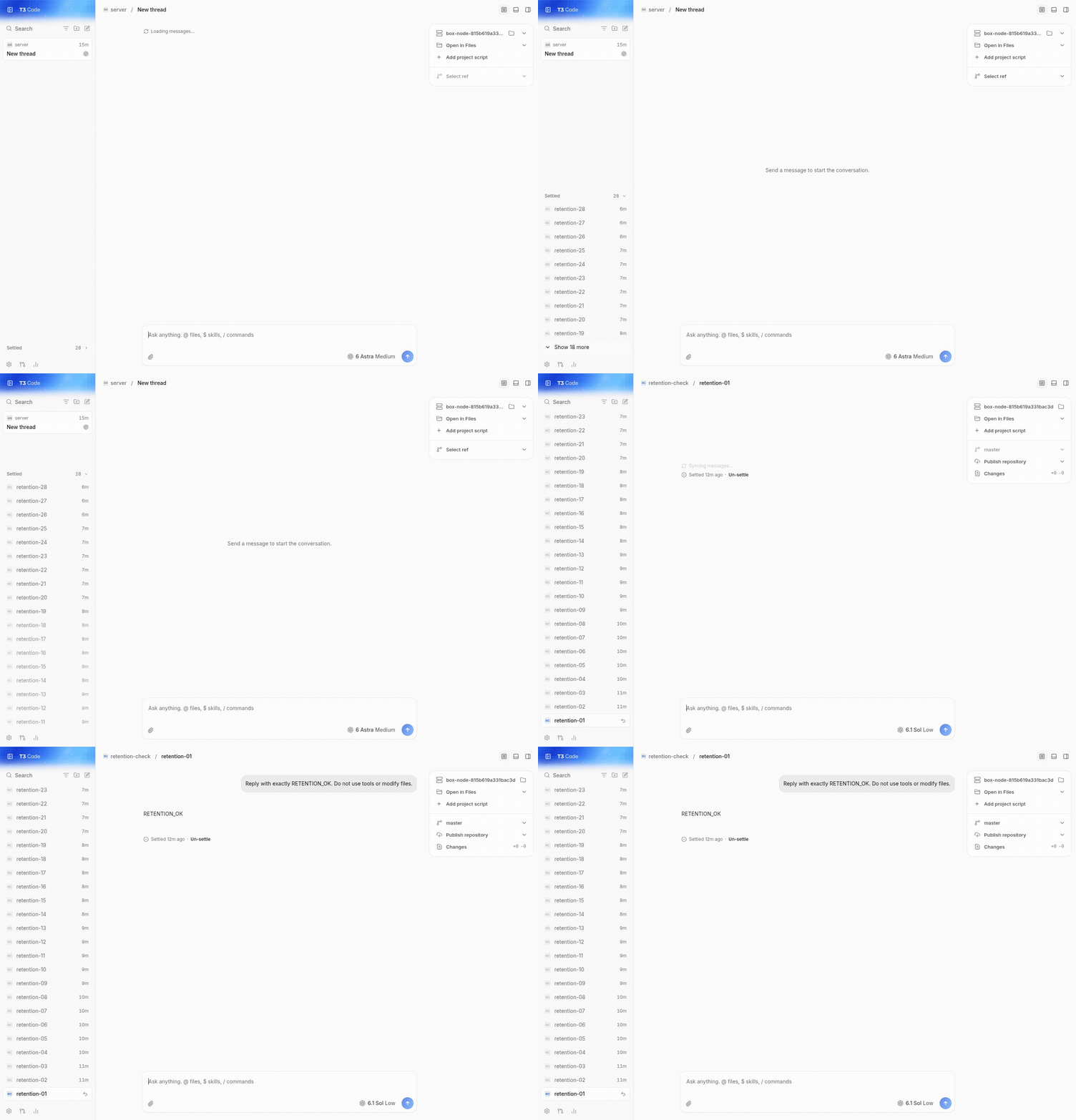
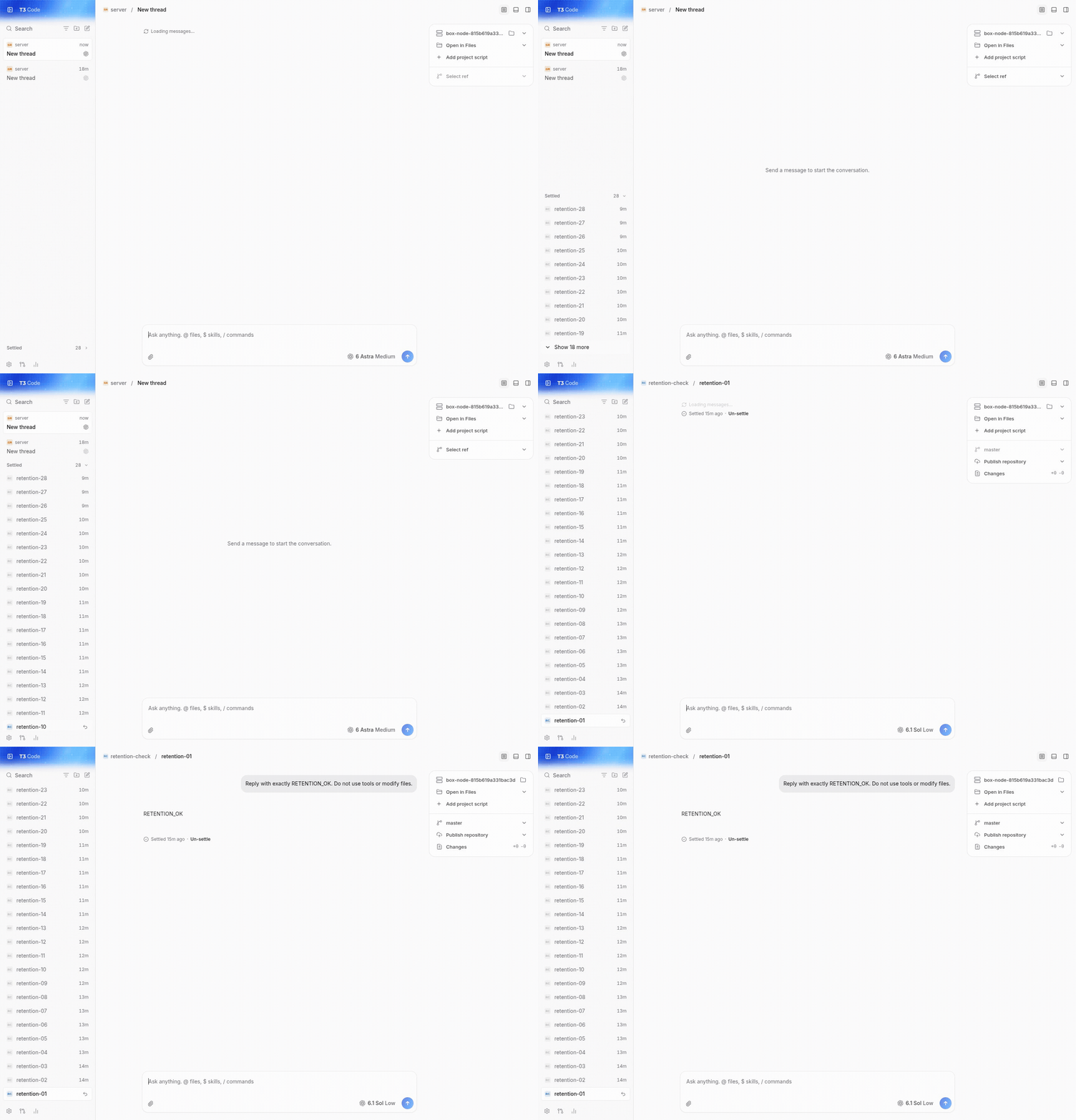
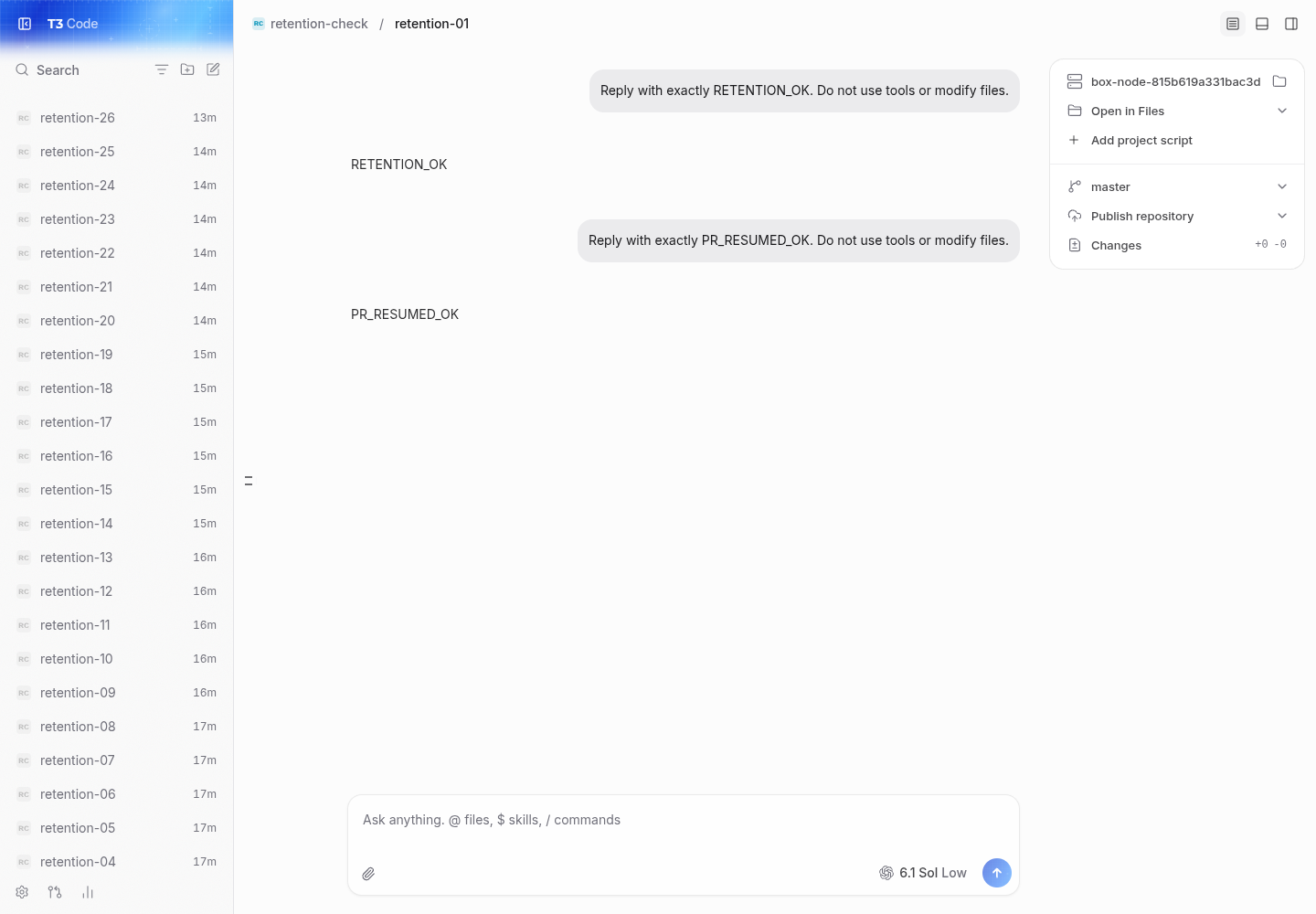
used repository playwright with /usr/bin/google-chrome. created a real git project and 28 conversations through the web ui, each with a completed codex gpt-6.1-sol turn, then settled them. stopped main before starting the pr and copied the stopped task-local data for the comparison. no mocks or seeded demo data.
fresh authenticated shell requests exercised the running server, with the debugger inspecting the timestamp array after collection:
freshly paired clients on both versions paged the settled shelf and opened the oldest real transcript. on the pr, pin/unpin and snooze/wake promoted an older thread back to active and fresh snapshots retained it. the restored conversation then completed another real codex turn, returning PR_RESUMED_OK.
blacksmith: all 18 shell-stream tests passed; vp run check:changed FETCH_HEAD~1 passed after fetching the exact head and its parent in the worker. format, lint, knip, graphql, affected typechecks, and 19 selected tests passed. the head also has 31 successful ci checks.
baseline history paging:
pr history paging:
Not verified
native ios/android and electron clients, other providers, remote relay/tunnel connections, and live subagent/side-chat retention were not exercised. equal-timestamp ties were covered by the existing shell tests, not manufactured in the app. this verifies bounded timestamp storage and preserved behavior; it does not revalidate the description's speed or allocated-byte percentages. the optional allocation sampling attempt timed out without usable measurements.
Restore the existing omitOlderSettledShells cases and replace the
reconnect integration test with one test that feeds the same settled
rows oldest-first, newest-first and shuffled, which is what can break
in the bounded heap.

Co-Authored-By: Claude Opus 5.5 <noreply@anthropic.com>
The automated pipeline stopped on this pull request and will not merge it:
the capture step could not show the problem on the base commit, so there is nothing to prove fixed.
Created 2 projects and 78 threads on each server; settled 64 with hourly ascending timestamps. Measured trimmed and untrimmed fresh HTTP snapshots with 50 warm-ups and 15 alternating batches of 200 requests per condition. Decoded each server's rows and measured untouched production trimming functions with 20,000 warm-ups and 15 alternating batches of 100,000 calls, pinned to the same CPU core. Compared returned IDs, ordering, cutoff and counts. Exercised cutoff ties and pin/snooze transitions through real server commands. Separately sampled allocations and observed cutoff-array lengths using diagnostic copies excluded from timing.
This file contains hidden or bidirectional Unicode text that may be interpreted or compiled differently than what appears below. To review, open the file in an editor that reveals hidden Unicode characters.
Learn more about bidirectional Unicode characters
size:S10-29 changed lines (additions + deletions).takeover:blockedTakeover blocked; reason in the PR bodyvouch:unvouchedAuthor is not yet trusted in the VOUCHED list.
3 participants
Add this suggestion to a batch that can be applied as a single commit.This suggestion is invalid because no changes were made to the code.Suggestions cannot be applied while the pull request is closed.Suggestions cannot be applied while viewing a subset of changes.Only one suggestion per line can be applied in a batch.Add this suggestion to a batch that can be applied as a single commit.Applying suggestions on deleted lines is not supported.You must change the existing code in this line in order to create a valid suggestion.Outdated suggestions cannot be applied.This suggestion has been applied or marked resolved.Suggestions cannot be applied from pending reviews.Suggestions cannot be applied on multi-line comments.Suggestions cannot be applied while the pull request is queued to merge.Suggestion cannot be applied right now. Please check back later.


 github-actions
Bot
added
vouch:unvouched






 juliusmarminge
added
the
takeover:in-progress


Problem
Shell snapshot trimming collects and sorts every eligible settled timestamp to select the 25th newest cutoff. This creates temporary storage proportional to settled history, although only 25 values are needed. A refreshed 2,403-open-PR catalog and targeted diffs found no existing cutoff optimization; #21082, #27975 and #21627 touch independent snapshot transport, SQL counts or PR-link behavior.
Solution
Keep at most 25 timestamps in a local min-heap. Its root is the same cutoff; counting, ties, input/output order, lineage exclusions, pinned/snoozed/live/ancestor exceptions, and reconnect state remain unchanged. There are no new exports or wire changes.
The local qualification uses the complete baseline/current
omitOlderSettledShellsexports. A read-only sanitized database supplies the canonicalupdated_at ASC, thread_id ASCordering, lineage, settlement timestamps, project grouping and pin/snooze fields for 78 active rows, 64 eligible settled. These fields feed complete schema-decoded shell templates; derived run fields are inert and time is fixed. Complete outputs agree and input immutability is checked. No private message text, title or path is published.Nine alternating batches of 5,000 calls and three GC-inclusive allocation samples measured 25.086 → 13.964 ms (1.80×), with 51.80% fewer sampled allocated bytes. Independent confirmation measured 25.173 → 14.120 ms (1.78×), with 52.05% fewer sampled bytes. Even maximum candidate allocation versus minimum baseline allocation remains above 50% reduction. This qualifies the measured in-memory trimming workload—not SQL, complete subscriber latency, retained heap or whole-app memory.
Known tradeoff: larger oldest-first synthetic histories can be 4–10% slower, despite 67–98% lower sampled allocation. That ordering is reachable through the real SQL sort; the real-shaped result does not erase this limitation. Random, newest-first and tied synthetic histories qualify at 351 and 10,000 rows, but this is not a universal no-slowdown claim. Local benchmarks and artifacts are deliberately excluded from the PR.
Existing tests were expanded before production edits: 18 shell tests plus 4 selected WebSocket/ProjectionStore integration cases pass (subscription trimming, history cursor/counts, deferred decode and subagent-family reads).
vp run check:changedis green, and a fresh batch of three independent Codex reviews is clean. The PR contains only production logic and its prewritten tests, with no visible UI or provider-specific change.Built with GPT-6.1 Sol in the Codex harness through T3 Code.
TLDR
shell-cutoff.mp4