

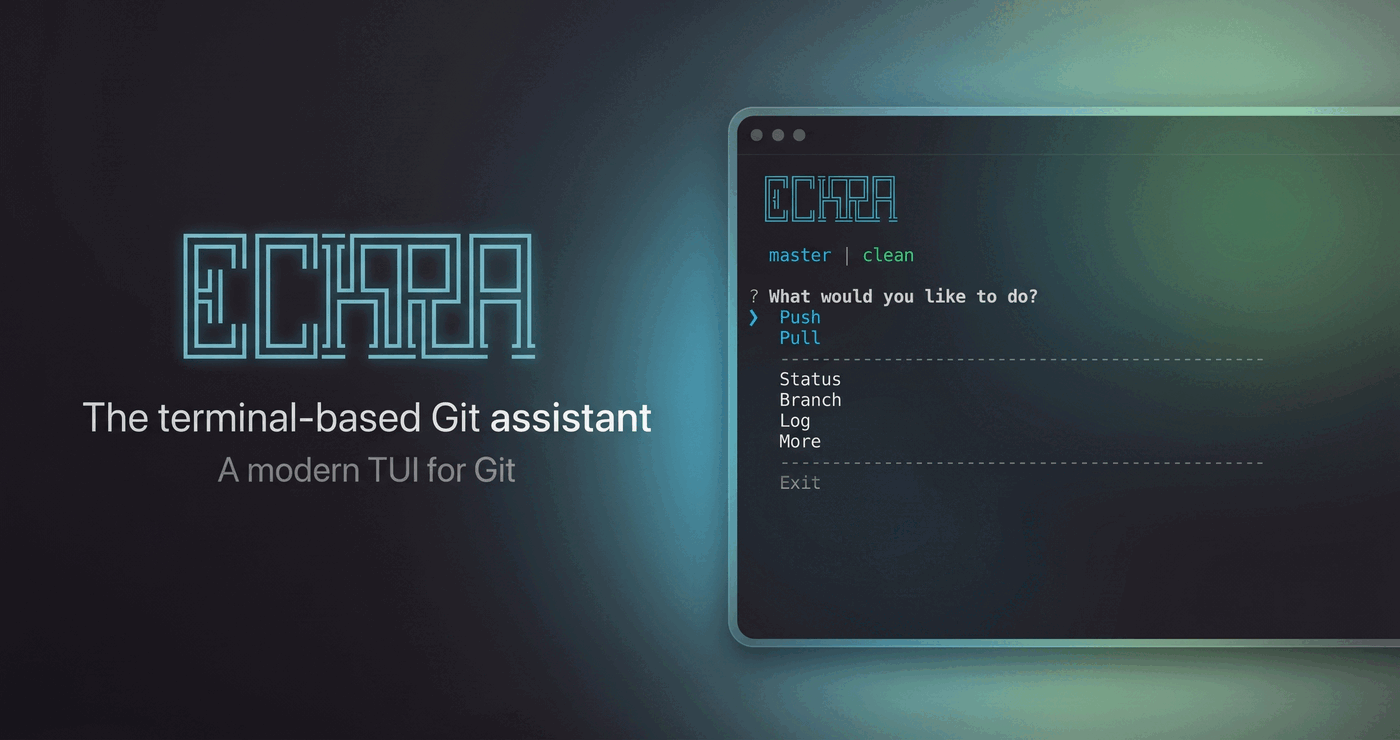
AI-powered Git management: commits, stories, and the whole repo in one place


eckra is an interactive, AI-powered Git management tool. It writes context-aware commit messages, turns your commit history into readable project stories, and brings staging, branches, stashes, and remotes into one dashboard. No config required to get started.
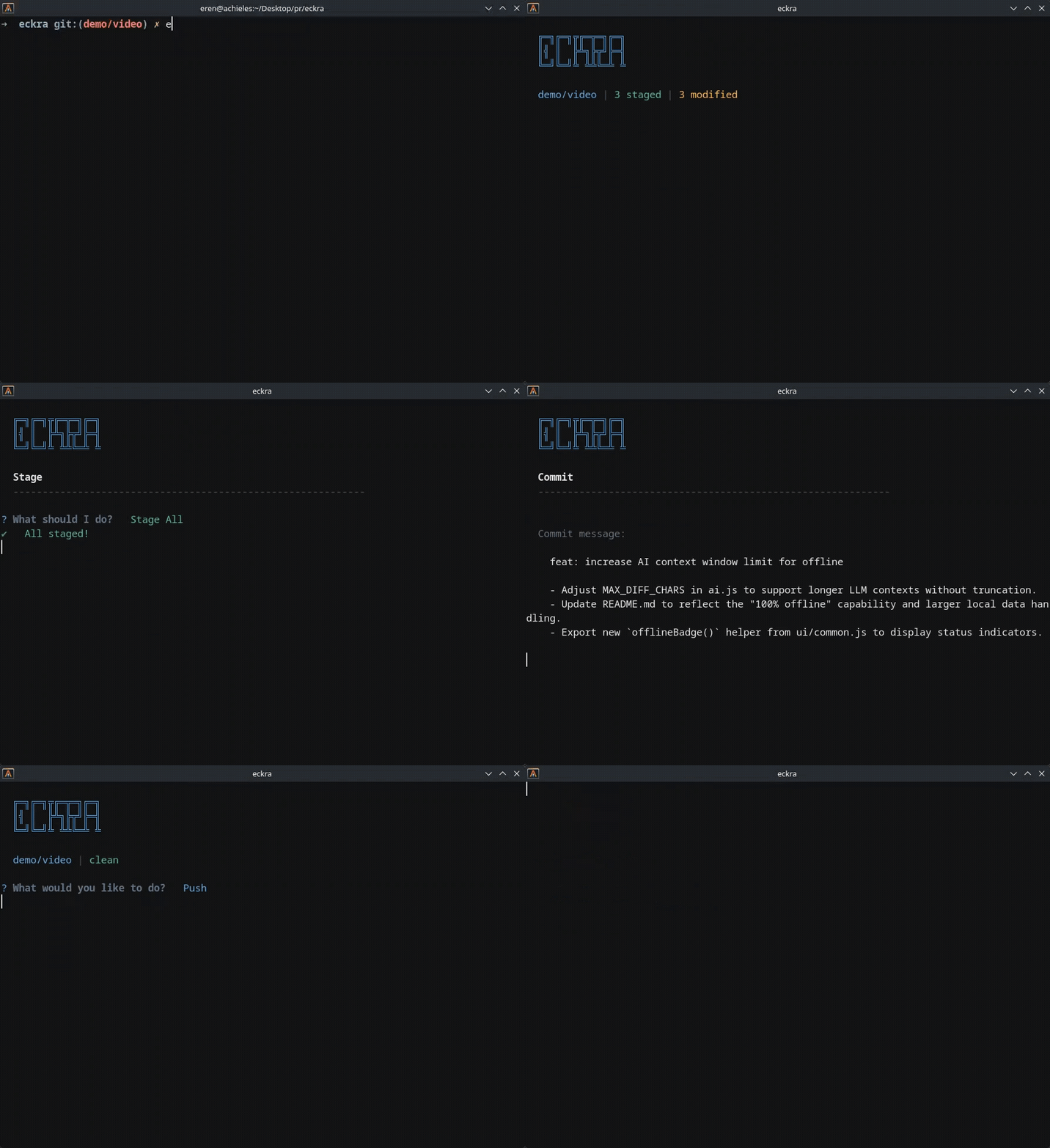
Interactive dashboard in action
- Works out of the box with Ollama: no API key needed to start, cloud providers are optional
- Interactive dashboard: manage staging, branches, stashes, and remotes from one menu
- AI commit messages based on your actual diff, with 11 AI providers (OpenAI, Anthropic, Gemini, DeepSeek, Amazon Bedrock, OpenCode Go, and more; see the provider table)
- Multiple providers & accounts: save several provider configurations side by side (e.g. two OpenAI accounts plus OpenRouter) and switch anytime from Settings or
eckra provider use - Select & edit any suggestion before committing
- Choose your commit format:
plain,conventional,conventional+body,gitmoji, orsubject+body(picked during setup, changeable in Settings or per-commit with--type) - Staged diff review with syntax highlighting
- Git Graph: VS Code-style commit graph across all branches, with per-lane colors, pagination, and commit inspection
- Project story: AI timeline of your commit history
- Lazygit integration: run eckra's commit flow inside lazygit
Install eckra globally:
npm install -g eckraeckra can bind directly to lazygit right after installing:
eckra lazygit installThen press C in lazygit's files view for an AI commit.
Run eckra in any Git repository to open the dashboard:
eckraNote
On first run, eckra walks you through a quick setup wizard (provider, model, and preferred commit format). You can re-run the setup anytime with eckra setup.
Or jump straight into action:
| Command | Alias | Action |
|---|---|---|
eckra commit |
c |
AI-assisted commit flow |
eckra status |
st |
Status and staged files |
eckra push |
p |
Push to remote |
eckra easy |
e |
Stage all, AI commit, push (confirms each step) |
eckra story |
t |
AI project timeline |
eckra graph |
g |
Interactive commit graph |
eckra start |
s |
Interactive dashboard |
eckra lazygit |
lg |
Lazygit AI-commit integration |
eckra config |
cfg |
View or edit config |
eckra provider |
pv |
Manage saved AI provider connections |
eckra doctor |
dr |
Health check |
eckra suggest |
sg |
Print an AI commit message |
eckra setup |
Run the setup/onboarding wizard | |
eckra model |
m |
Show current AI settings & switch/manage providers |
Tip
eckra e stages everything, generates an AI message, and asks you before committing and pushing.
From the dashboard you can also open Git Graph (under Branch) to see your full commit topology across all branches, page through history, and inspect commits for cherry-picking.
Use eckra's AI commit flow inside lazygit:
eckra lazygit install- Restart lazygit and stage your files
- Open the files view and press
C(uppercase) - Review the generated commit message and confirm
eckra opens full-screen, writes the message, and commits once you approve.
The key defaults to C (uppercase). If it collides with a lazygit shortcut you already use, pick another letter:
eckra config set lazygitKey g
eckra lazygit install    # re-applies the new key to lazygit's config
eckra warns you when the chosen letter is bound by a default lazygit shortcut, but lets you keep it anyway.
Manage the integration:
eckra lazygit            # Status + YAML snippet
eckra lazygit install    # Add the custom command
eckra lazygit remove # Remove iteckra commit flags:
| Flag | Alias | Action |
|---|---|---|
--message <text> |
-m |
Commit with this message, skip AI |
--all |
-a |
Stage all changes before generating |
--yes |
-y |
Skip the confirmation prompt |
--generate <count> |
-g |
Generate N messages to pick from |
--type <format> |
-t |
Commit message format (see below) |
--clipboard |
-c |
Copy the message to the clipboard instead of committing |
--no-verify |
-n |
Bypass pre-commit and commit-msg hooks |
--exclude <files> |
-x |
Exclude files/glob patterns from AI analysis (comma-separated) |
--max-length <n> |
Preferred max subject length (default 50) | |
--instruction <text> |
Extra instruction for the AI | |
--no-commit |
Only generate and show the message |
--type (or the commitType config, chosen during setup) selects the format the AI writes in:
| Format | Example subject |
|---|---|
plain |
add autocomplete search |
conventional |
feat(auth): add login |
conventional+body |
feat: add login + bullets (default) |
gitmoji |
✨ feat(auth): add login |
subject+body |
add login + bullets |
Other commands:
eckra push -y                              # push without the confirmation prompt
eckra suggest --all --instruction "focus on the why"   # non-interactive, stdout
eckra suggest --output commit-msg.txt                  # write to a file (CI-friendly)
eckra story --count 20                                 # analyze the last 20 commits
eckra commit --type gitmoji                            # gitmoji-style message
eckra commit --clipboard                               # copy the message, don't commit
eckra commit -x "*.lock,config.local.js"              # ignore files in AI analysis
Risky operations ask for confirmation before running: push, pull, push tags, delete tag, drop stash, amend, rebase and squash. Pass -y/--yes on eckra push to skip it.
eckra works out of the box with Ollama (http://localhost:11434) using the lightweight qwen3.5:2b model:
ollama pull qwen3.5:2b| Provider | Setup | Default Model |
|---|---|---|
Ollama |
Local server, default http://localhost:11434 |
qwen3.5:2b |
LM Studio |
Local server, default http://localhost:1234 |
(user-configured) |
| Provider | Requires | Default Model |
|---|---|---|
OpenAI |
OpenAI API key | gpt-5-mini |
Anthropic (Claude) |
Anthropic API key | claude-haiku-4-5-20251001 |
Google Gemini |
Google AI Studio API key | gemini-3.1-flash-lite |
OpenRouter |
OpenRouter API key | openai/gpt-oss-120b |
DeepSeek |
DeepSeek API key | deepseek-chat |
OpenCode Go |
OpenCode Go API key | deepseek-v4-flash |
Ollama Cloud |
Ollama Cloud API key (ollama.com/settings/keys) | qwen3.5:2b |
Amazon Bedrock |
Bedrock API key + AWS Region (bedrock-runtime endpoint) |
us.anthropic.claude-haiku-4-5 |
Amazon Bedrock Mantle |
Bedrock API key + AWS Region (bedrock-mantle endpoint) |
us.anthropic.claude-haiku-4-5 |
Providers are configured during setup and stored as named connections in ~/.eckra/config.json. The configuration you pick during eckra setup becomes your default connection. eckra fetches the available models for you. Run eckra model to see your current AI settings (provider, connection, model, masked API key) and where they are stored, then switch or manage providers from the same menu.
eckra stores several provider configurations side by side, including different providers and/or multiple accounts for the same provider (e.g. a work and a personal OpenAI key). One connection is active at a time and every AI call uses it. With no explicit choice, eckra falls back to the default connection. You can override this per run with ECKRA_ACTIVE_AI_CONNECTION or pin a connection to a single repository with eckra provider use <name> --local, which is saved in .eckrarc.
The AI surfaces expose exactly two actions: Switch Provider / Account (pick an existing connection) and Manage Providers (everything else: add, edit credentials/model per connection, rename, delete). They live in the Settings menu and behind eckra model:
eckra provider list              # All saved connections, active marked with ✓
eckra provider add               # Interactive wizard: provider → key → model → name
eckra provider add --name work --provider openai \
  --set openaiApiKey=sk-... openaiModel=gpt-5-mini --use   # Non-interactive
eckra provider edit work         # Wizard: fix the API key or change the model
eckra provider use work          # Switch globally
eckra provider use home --local  # Pin a connection to this repo only (.eckrarc)
eckra provider show work         # Details (secrets masked)
eckra provider rename work is    # Rename (stays active if it was)
eckra provider remove work -y # Deleteeckra config # Show config (secrets masked)
eckra config get aiProvider # Print a value
eckra config get aiProvider theme # Print several values at once
eckra config set theme dark # Set a value
eckra config set theme=dark locale=tr # Set several key=value pairs at once
eckra config unset aiInstruction# Remove a key
eckra config reset # Restore defaults
eckra config path # Config file pathNote
Add --local to target the project's .eckrarc instead. This file is gitignored as it can hold API keys.
A few useful keys: commitType (commit message format), subjectMaxLength (max subject characters, default 50), locale (language for messages, default en), timeout (AI request timeout in ms, default 30000), and activeAiConnection (the saved connection in use). Provider credentials and models live inside named connections. Manage them with eckra provider / eckra model, not eckra config set (which now rejects those keys with guidance). If you are upgrading from an older version, existing flat settings are migrated automatically into a default connection on first run and the old keys are kept for downgrade safety.
eckra doctor checks Git, config, and the AI provider connection. Use --no-provider for an offline check or --json for CI. It exits with code 1 when any check fails.
eckra update checks the npm registry and upgrades the global package:
eckra update            # Check and update (asks for confirmation)
eckra update --check    # Check only (exit code 1 if an update is available)
eckra update --yes      # Update without confirmation
You can also check from the menu: More > Check for Updates.
Note
Running eckra via npx eckra always uses the latest version, no update needed.
eckra suggest prints a commit message to stdout without any prompts:
eckra suggest                    # Message for staged changes
eckra suggest --all              # Stage everything first
eckra suggest --instruction "focus on the why"
eckra suggest --type gitmoji     # Pick the commit message format
eckra suggest -x "dist/" # Exclude files from the analysis- "AI Provider Error" / connection failed: run
eckra doctorto see exactly what's failing, then check the API key and model in More > Settings. - Wrong account or provider in use: check which connection is active with
eckra provider listand switch witheckra provider use <name>. - Ollama errors: make sure the server is running (
ollama serve) and the model is pulled:ollama pull qwen3.5:2b. - 401 Unauthorized: the API key is wrong or expired. Re-enter it in More > Settings or set it via
eckra config set <key> <value>. - AI returns a warning or empty message: some providers flag safe content; try a different model or check the provider's dashboard for rate limits.
- Large diffs are truncated: prompts are capped at 2000 characters by design. Commit in smaller chunks or stage related files only.
Please see CONTRIBUTING.md.
- In-app:
eckra→ More > Settings → Uninstall Eckra → typeuninstall. This also removes the lazygit integration. - Manual:
eckra lazygit remove   # remove the lazygit integration first (if you have it)
npm uninstall -g eckra
rm -rf ~/.eckraDistributed under the MIT License. See LICENSE for more information.